

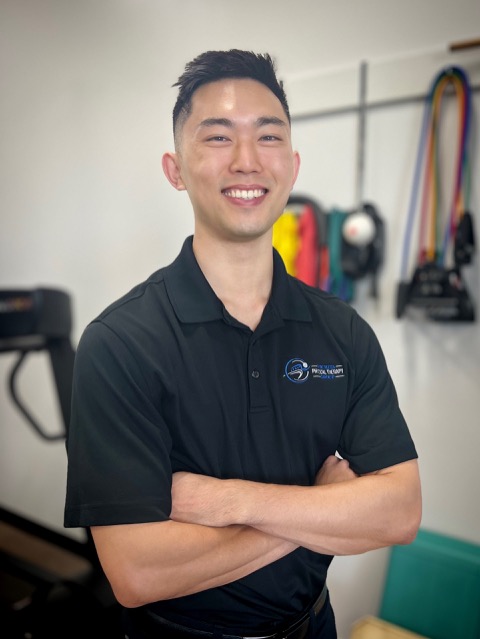
Keenan Dung, DPT
Education
- Creighton University – 2023 (DPT)
- University of the Pacific – 2020 (B.S. in Exercise Science)
Focus
- Sports Rehabilitation
- Orthopedic Rehabilitation
Powerlifting Physical Therapy & Rehabilitation in Wichita, KS
Powerlifting places massive demands on the body.
Heavy squats, deadlifts, and bench pressing create high levels of spinal loading, joint compression, tissue stress, and repetitive strain that can eventually lead to pain, mobility restrictions, compensation patterns, and performance limitations.
At Wichita Physical Therapy Group, we help powerlifters recover from injuries, improve movement efficiency, restore mobility, and safely return to heavy training.
Whether you compete in powerlifting, train recreationally, or simply enjoy strength training, our goal is to help you continue lifting without constantly fighting pain or movement limitations.
Powerlifting Injury Rehabilitation in Wichita
Powerlifting injuries often develop from:
- repetitive loading,
- mobility limitations,
- poor recovery,
- strength imbalances,
- technique breakdown,
- or accumulated tissue stress over time.
We commonly help lifters dealing with:
- Low back pain
- Disc irritation
- SI joint dysfunction
- Hip impingement
- Shoulder pain
- Rotator cuff irritation
- Bench press shoulder strain
- Elbow pain
- Wrist pain
- Patellar tendon pain
- Quad strains
- Hamstring strains
- Knee pain during squatting
- Deadlift-related spinal irritation
- Mobility restrictions
- Chronic tightness and stiffness
- Post-surgical rehabilitation
Many lifters continue training around pain for months before addressing the underlying issue.
Unfortunately, compensation patterns usually worsen over time when the root problem is ignored.
Why Powerlifting Injuries Often Keep Returning
Strength alone does not guarantee efficient movement.
A lifter may still have:
- limited hip mobility,
- poor thoracic extension,
- core instability,
- asymmetrical loading patterns,
- restricted ankle mobility,
- or faulty movement mechanics.
Those limitations can place abnormal stress on joints and soft tissues under heavy load.
At Wichita Physical Therapy Group, we evaluate the entire movement system instead of simply treating the painful area.
That helps identify what is truly driving the problem.
Our Powerlifting Rehabilitation Approach
Powerlifting rehabilitation may involve:
- Manual therapy
- Joint mobility treatment
- Soft tissue treatment
- Squat movement analysis
- Deadlift mechanics evaluation
- Bench press movement correction
- Hip mobility restoration
- Thoracic mobility work
- Core stabilization
- Strength progression
- Load management strategies
- Recovery optimization
- Functional movement retraining
The goal is not to tell athletes to stop lifting forever.
The goal is helping them move better so they can continue training more safely and efficiently long term.
Common Powerlifting Injuries We Treat
Low Back Pain
Heavy spinal loading combined with poor bracing mechanics, mobility restrictions, or fatigue commonly contributes to lifting-related back pain.
Shoulder Pain During Bench Press
Bench press injuries frequently involve shoulder instability, mobility deficits, rotator cuff irritation, or excessive tissue stress from poor positioning.
Hip Impingement
Limited hip mobility and repetitive deep loading patterns can contribute to pinching, stiffness, and restricted squat mechanics.
Knee Pain During Squats
Poor movement mechanics, ankle mobility restrictions, strength imbalances, and loading compensation patterns often contribute to squat-related knee pain.
Elbow and Wrist Pain
Heavy pressing and gripping volume can overload tendons and soft tissues throughout the upper extremity.
Quote From Jon Harris, PT, FAAOMPT
“Powerlifters are incredibly strong athletes, but strength without efficient movement eventually creates compensation somewhere in the system.”
— Jon Harris, PT, FAAOMPT
Frequently Asked Questions
Can I continue lifting during physical therapy?
In many cases, yes. Activity modification depends on tissue irritation, movement quality, load tolerance, and injury severity.
Do you work with competitive powerlifters?
Yes. We work with competitive lifters, strength athletes, recreational lifters, and active adults.
Why does my back hurt when deadlifting?
Back pain during deadlifting may involve bracing deficits, mobility restrictions, fatigue, spinal loading intolerance, or movement compensation patterns.
Can physical therapy improve squat mobility?
Absolutely. Improving hip, ankle, and thoracic mobility often helps improve squat mechanics and reduce stress on the knees and spine.
Can you help with chronic lifting injuries?
Yes. Many chronic lifting injuries involve unresolved movement dysfunction and repetitive overload patterns that were never fully corrected.
Powerlifting Physical Therapy in Wichita
Wichita Physical Therapy Group
(316) 358-9942
2146 N Collective Ln Ste 114
Wichita, KS 67206